Showing posts with label Knitting. Show all posts

Monday, February 15, 2016

Be Mine, Crafty Valentine

Happy half-priced candy day! I hope all my lovely readers enjoyed their day of flirtatious frivolity (Or grump, as you prefer.) With all my Valentine cards delivered I can now them share with you, so here's the highlights from this year's collection of very punny crafting cards.


Because we all know, a crafter's first love is the fiber! (Or string, or paper, or wood, or whatever we made things from...) Happy V-Day!

Thursday, January 28, 2016

Ace of Lace - Rockstar Knitting

While in Tallinn we naturally found a good bar, one with a long beer list. (We are always wanting to try new beers wherever we go, and Estonia had a remarkably thriving brewing scene!) The waitress saw me knitting, and fetched a small post card. "My friend, he owns clubs, and he knits. You should go see his knitting."

Now, I am a lover of the fiber arts, and will vehemently defend their title as ARTS as well as crafts. But I was a bit surprised, a gallery of knitting? Not a museum with traditional patterns and ethnographic pieces?


We found the building (13th c. and still looking good!), and wound up narrow steps to the gallery space. What should meet my eyes but huge round mandalas of lace - Niebling Shawls pinned out on black velvet.

And what, pray tell, is a Niebling? In knitting circles the name is fairly well known, they are challenging patterns and represent a considerable investment of time and yarn. The man (yes, a man!) behind the patterns is less well known.


Herbert R. Niebling (1903-1966) was a German textile designer with an interest in mathematics. The round shawls he is best known for are excellent examples of mathematical growth structures. Each section is knit in the round with a set number of repeats, then a row or two are knit with a considerable number of increases, and the next section will either have 2-4 times the number of repeats, or a repeated pattern that is 2x-4x larger. Thus, sections grow and expand organically.

The variety of motifs is impressive, from common lace leaf patterns to detailed realistic shapes and geometric designs. Many of the motifs can be found in older knitting patterns, and represent a number of ethnographic sources, but some may have been invented by Niebling himself. That is, however impossible to know, as patterns were rarely written down, and the exact date of an object can be difficult to judge!


Which is the other neat thing about Niebling, he created a system of charting stitches that is now almost universal. One could, without speaking a word of German, pick up an old pattern and knit it, assuming one has been trained in modern knitting charts (or has Google.)

I have seen a number of Niebling shawls in person, both on the needles and on the back. Even knit in very small yarn and needles they tend to be large and impressive textiles! With a heavier yarn and appropriate gauge of needle the doilies become massive bed covers.

However, this exhibit was perhaps the finest lace work I've ever seen. These pieces are much easier to appreciate when blocked wide and seen clearly against a backdrop. Even the non-crafting Mr. Crafty was impressed by the images and designs.

And the second artistry of these is the blocking! Not only were they perfect circles with each point carefully stretched and pinned, but the sway and flow of stitches was carefully arranged. The leaves and flowers tilted carefully, while the in-between stitches were stretched or compressed to allow the entire piece to lay perfectly flat.
I'm going to take a brief moment to remind you, gentle reader, that both the master pattern maker and the skilled knitter here are not your grandmother. In fact, they are both men. So if anyone gives you any bullshit about knitting being a strictly feminine pastime, after you're done lecturing them about medieval knitting guilds, push their face in this and tell them to *redacted*
The pieces ranged from large mandalas, about 4 ft. across, to smaller doilies perhaps only 1 ft. wide.

Here we see the beginnings of a shawl, in fine estonian wool, with wine corks as stitch savers. I mentioned that this guy owned a rock club, right?
A very worthwhile experience in Tallinn! Get a beer at Hopster and then run over and drop a few euros on this gallery, it's well worth it! Even if you're not a stitching enthusiast.

Thursday, January 14, 2016

Muhu Island - Fishermen and Twilight


 On our jaunts around Estonia we had a quick trip to Muhu island. The island is noted for distinct cultural practices, and a very clear knitting style. (The drawings in that link? Those came from the students at the Heimtali School Museum.) Even the common colors, notably orange, were not used on the mainland.
 We stayed at a small farm house in the village of Koguva, an old fisher village that is well preserved and hosts the Muhu museum.
 As we walked the shores (late in the evening, as it goes in Midsummer,) we explored the old boats up on shore, and quietly watched a fisherman and a small child enjoying the peaceful evening.
 I love this little tiny boat! It's so tall!
 Koguva also hosts the oldest functioning windmill in Estonia (so said the local brochures, I've not been able to corroborate online.) It faced out on the Baltic, looking across to the island of Saaremaa.

 I found that the traditional housing style reminded me of Jomon Japan from my visits there. Many of these houses are listed as being hundreds of years old, with the usual thatching re-done periodically.
 What a wonderful way to end the day!
Stay tuned for more about our visit to Muhu, and the ancient cultural attractions there.

Wednesday, December 30, 2015

WIP Wednesday - Getting Foxy

A WIP, almost 3/4 done! A friend was looking for fingerless mitts, and I couldn't resist. (I do have enough yarn, after all.) He's a fan of Foxes, and researching his ancestry. Thus, a pattern was born - a friendly fox, and some polish embroidery designs!

Now, I am in fact a rather lazy knitter. I did not set out to create a pattern for this! But Ravelry couldn't provide me with a chart of the sort I desired, so I was forced to make my own. After the mitts are complete I expect that I may clean up the pattern and put it out for the universe to use as they see fit, since the world needs more foxy folks...

Tuesday, November 10, 2015

Heimtali School Museum - Native Textiles

During our week of workshops in Estonia, we had a Field Trip to the Heimtali School Museum. It's an old parish school, similar to the one room schoolhouses of the American west. In fact, any students who lived far away would sleep in the upstairs and go home on weekends!

The school is still in use, but the classes are for students from Viljandi who are recording and conserving textiles, and for youth who are learning about Estonian culture. In a recent project, the fence posts were painted in the style of traditional mittens! (Take that, Pinterest!)
The youngsters also made these, a project to rescue a lonely glove when you've lost its mate. It's a small and simple way to teach them traditional skills and patterns.


The collection included traditional weavings - these remind me of pieces from the American southwest! Surprisingly, the stripes are created in weft, instead of warp.
Here is an entrelac crochet blanket, being held up by Anu - the museum's curator and a champion of Estonian Native textiles.
Here's an embroidered blanket with crochet borders. Anu told us that, after the collapse of the USSR, she would find these old blankets being used for dirty jobs and neglected. She said that she would go buy cheap blankets, and trade them to people she saw using them for things like placing car parts and gardening.
This one is crocheted, with embroidery on it!
Here is a pair of socks in the characteristic bright orange of the Islands. They were gotten from a young woman who was embarrassed to wear them, but they were knitted by her grandmother. She wanted to be more fashionable.


Here we have some of the traditional mittens, along with a detailed record of the pattern.
Students from the College learn to draw extremely detailed records of the collection, many of these I could have used as a knitting pattern!
Anu has written a book of patterns for stuffed animals and puppets that use Estonian patterns. She wants children to be able to recognize and name some of the many patterns that are part of their heritage! As a knitter, a stuffy is also more accessible than knitting an entire sweater on size 00 needles...
The museum included a selection of traditional farm tools, including these cards and combs. There were also a number of models of people doing traditional work and play that involved horses.

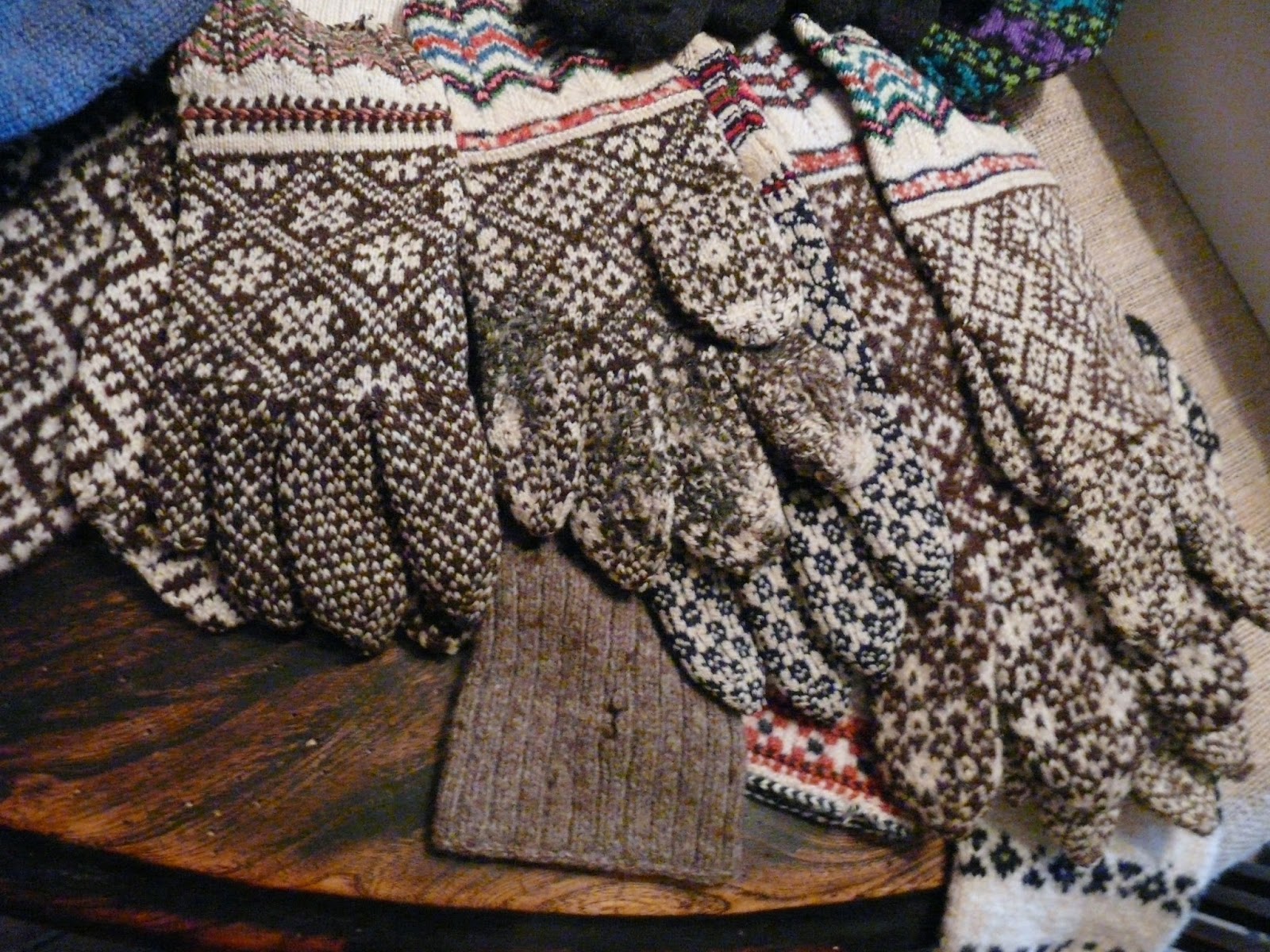
And here, in careful storage, is the meat of the collection. Knit garments from around the country and islands! Mittens, which can be traced to their origin by pattern and colors alone. Above, the mittens in black with greens and purples, are very modern takes on old patterns. The use of black/brown/grey with white and red is more common.
Here we have a pair of very simple gloves, but they have been darned and darned and darned some more! Well loved...
A baby bonnet, with a traditional "eye" on the forehead. All baby hats had such a structure to protect the infant from evil spirits and the like. Even today the custom is still common throughout the country.
And an entire dresser full of tablet and inkle woven ribbons! The patterns ranged from very old, to complex modern styles. The most common colors were red and white, and motifs with sun wheels and crosses were the norm.
Pawing through the collection (With gloves on!) was a textile historian's dream! However, having the curator on hand to give you the stories behind some of the objects was half of the experience. A blog post is coming up where I'll show you Anu's studio and tell you more about her work!

EDIT - REGISTRATION IS OPEN FOR 2016 CRAFT CAMP.
You too, gentle reader, could enjoy the culture and craftiness of Estonia!