Showing posts with label viking. Show all posts

Friday, June 3, 2016

Thingvellir National Park - Iceland

This year we (once again) explored the surreal landscapes of Iceland. On a drizzly, foggy day we ventured into the wilds of Thingviller National Park. As the name suggests, it was the site of the historic meetings, but it is also a spot well renowned for it's natural beauty.


Through the middle of the park, and running into the bottom of the large lake, is the seam between the North American and Eurasian crustal plates. The chasm plummets underwater more than 50m, and with a good wetsuit it is possible to swim between two continents.

Even in the fog we went looking for new vantage points, and climbed an extremely steep ( I live in the Rocky Mountains, this road was the steepest I've ever seen!) road up and over a volcanic range. The tops of the mountains were an alien landscape, the road dipped and turned sharply to move between the lava crags. A carpet of tundra grasses and moss clung to the black and red stone.


Hiking trails snaked along the peaks, with lots of snow lingering. We could see that people take skis here in the winter, as well as some kind of tracked vehicles. The snow banks kept us from going too far into the wilds.

Descending into the valley again, we saw huge plumes of steam rising into the clouds. We had followed, up and down this mad road, a large grey pipe that snaked and turned over the stones, occasionally dipping underground. We discovered the source - A massive hot springs that supplies all of the hot water for the city of Reykjavik. All the showers, dishwashing, even radiator heating in the city is supplied by this pipe!

Also, we stopped and had a bite and some beers at Ion Hotel. The food was great and the view was amazing from their lounge! Staying there might be a bit rich for many folks, but it's worthwhile to enjoy a cocktail!

We continued around the lake, the clouds rising and falling. The landscape is rolling fields of lava rock, and small pastures and fields, punctuated by steep sloped berms of old flows eroding. This early in the spring it's covered in the otherworldly green moss, and the tough grasses and willows in pale yellow and rust red.

We then came to the space between worlds - Thingviller itself! A river meanders across the broad rift valley and heads for the old church, and the lake beyond. Within an impressive canyon, created by the splitting of the rock instead of the passage of water, a creek flows and then falls to the valley floor. This place was historically the site of the Althing, or great meeting.


The icelanders began meeting in this area in 930 and it grew to be a very important spot. There was adequate water and forage in the area for the horses of all the visitors, and space for tents as well. It was somewhat central to the most settled parts of the island as well. But the most important, and impressive feature is the natural amphitheater that allows one to speak to a large crowd without amplification.


From August 2012, notice how much greener it was!

The purpose of an this Althing, was to elect a lawspeaker. That lawspeaker would be someone respected in the community and trusted by the folks there. They would then recite the laws that everyone was to follow for the following year. Thus, if a change was needed in this law code it would be made.


So this, the oldest parliament in the world, was the site of the only peaceable conversion of a nation in Europe.  In 1000 , after much stirring up and agitation by Norwegian representatives, it was decided that the nation would all convert to Christianity. The reasoning was that it was impractical and unfair to have two sets of laws governing those of different religions. However, many old practices that were taboo to Christians were allowed to continue in order to ease the transition. This allowed for considerable tradition and folklore to survive long enough to be recorded. And, of course, there were some holdouts who resisted the change, moved to the Westfjords, and continued to practice the old ways...


From August 2012, notice how much greener it was!


Monday, August 24, 2015

Craft Camp - Bone Carving

Greetings bloglanders, the madness has calmed a bit and I'm ready to begin posting more about our trip to Estonia and Finland!  First up, the meat of the experience - Craft Camp. Day one - bone carving!

The workshop is full of old-school tools for woodworking and such. Fortunately we were granted access to electricity and some modern pieces. These are the types of tools that require a class to use properly! We did, however use hand saws, a good arm exercise.


Our instructor had already done much of the prep work. She gets bins of bones from butchers and the like. She also told us that the hunting laws in Estonia stipulate that the right jaw bone of each elk killed is sent to the University for census purposes. After recording the info they are just given away, she has the hook-up!
She cuts the bones into pieces, and then places them in a metal basket. The whole container is left in a swift flowing river for three days and the bones are tumble to a smooth edge. Fucking Brilliant! (This is why she makes the big bucks, I suppose.) 

She had dyed some of the pieces with wool dyes.
 Good thing too, as the sanding process was most of the work we did! Here's a few antler pieces I sawed off to make into buttons. They needed plenty of sanding to become smooth enough for use.

I imagine our ancestors, lacking sandpaper, may have used the river tumbling trick for most things!

 My main project for the morning was a traditional needle case. The main part is a hollow leg bone, it was filed down inside and decorated. with a rune circle.

A dremel was used to create the indentations, and colored beeswax smeared on it to bring out the design. The top and bottom are jawbone segments, one with the tooth still rattling about. The needles go into the piece of felt, which is then pulled into the bone shaft.
 The afternoon was focused on a pair of bone needles and a brooch. The needle on top is the instructor's sample. The middle one has been thinned and shaped down. The bottom one is the fresh cut of bone.

I ended up using my knife to whittle the bones, as the sanding was slower and hurt my hands!
 Folks in the class made a variety of things, with different bright colors and carved patterns galore! (I am too practical for little bone trinkets.)

The circle with dot pattern is a traditional Estonian motif - the dot represents the self, the circle is the world around us. Sometimes simple designs are more than meets the eye.

I'll be posting, in the coming weeks, about my other three workshops and our experiences in Estonia!

EDIT - REGISTRATION IS OPEN FOR 2016 CRAFT CAMP.
You too, gentle reader, could enjoy the culture and craftiness of Estonia!

Saturday, February 28, 2015

No Waste Sewing (Almost!)

I made a thing! Not just anything, a Hangeroc inspired dress, with functional pockets and a fun swishy hem line. And this entire dress only took two yards of fabric. Yep, two yards.
Why is that number important? I mean, it's not that hard to make a dress with two yards... is it? Actually, it is. For a dress with an ample swingy shape that fits a medium sized frame two yards is almost a miracle. Two yards of fabric means saving lots of money (have you seen the price of fabric?) And also saving a lot of waste.


Let's talk scraps. Because I have lots of scraps. (Seriously, lots) And I LOVE scraps, cute little bits that are a memory of making a piece of clothing. I get bags of scraps from family, friends, estate sales, the local craft shop... sewing makes scraps. 

 This, this is all the scraps I have from making that dress. A few strip from squaring off the end of the fabric, the corners of my pockets, and those triangles are from straightening one section of hem. I think with some fiddling I could do away with that as well.


 How? Well, for inspiration I went back in history, waaaaay back! Consider this, if you have to hand wash, card and pick, handspin, dye, weave, and full every square inch of fabric in a garment, you ain't wasting it! Medieval reenactors have come up with a scheme for making an "Apron Dress" which has only straight line cuts and no waste.

The main shape of the dress is on the bottom of my drawing, the triangles above become the extra gores to make it ample and full, straps, facings, and pockets are all cut from the rest. The main difference from this and a reproduction piece is that I added some shaping for a modern silhouette. Thus, I needed a closure instead of having it loose enough to simply pull over my head.
 And here we are, a few hours of sewing, two yards of fabric - a cute, functional piece. And almost no scraps! Whatever will I use for decorating bags...

Thursday, November 13, 2014

VIking Sweater

The boat has sailed! Off to explore new lands and bring back great riches, the Viking Boat sweater is now keeping me warm thru chilly nights and grand adventures.

It began as a simple idea, I was inspired by Betsala's project on Ravelry, a brilliant take on an oversized drop sleeve sweater. I picked up large quantities of Imperial Ranch yarn on sale, one skein goes a long way and I got several! As always, I needed to change every last thing about the design, I never follow patterns! I have grown fond of yoked increases, so I spotted a nice chart for my fingering yarn. (in Norwegian of course, no matter for the chart tho.)


I ended up re-doing the chart, simple because the "x" in a grid is hell on the eyes after a short while! The chart itself was not difficult to follow, but very time consuming, and it needed plenty of table space! Each round on the sweater involved doing four passes of the chart, back and forth for the mirroring. The upside is that a pictorial chart like this makes it very easy to see if you're doing it right!


Beneath the main chart I went back into the red and black. I wanted something suitably scandinavian, but also badass - the Deathflake was the answer! I altered the skull to look like a dragon's head so there weren't too many conflicting motifs.

Below that I did two repeats of Furthak runes, charted myself. They are all straight lines, so it's not that hard!


As for the sleeves (It's soooo sad to get to the bottom of the body and realize, with horror, that the sleeves are yet to come. *sigh*) I decided to go with the traditional "lice pattern". Sounds tasty? I'm guessing that's why many fiber people just call it a Setesdal. It's nice and simple, but still involves the stranded carry, for extra warmth.

The bottom of the sleeves and body had a basic colorwork pattern from the Setesdal Sweater book I picked up in Norway.

In traditional style the sweater was steeked. In non-traditional style I put in a zipper instead of fussing with a button band. It was sewn in by machine and simply tacked down without a covering ribbon.

Then I tested it out by going in to the high mountains and drinking, just like a Norsewoman.
But wait, there's more! (Yarn, that is. I told you, these skeins are huuuge!) I was digging the red and black, and I do enjoy colorwork. It's super warm and sturdy. I pulled up ye olde Deathflake, and found a chart for some mittens. As I cannot stand to simple knit a pattern straight thru (see above), and Mr. Crafty prefers gloves, I gave them a split finger. Perfect for cycling in the cold!
What did you make this summer for the cold season? I, for one, am delighted for Skadi's return!

Monday, August 20, 2012

Grave Goods and Goodies

We visited the National Museum in Reykjavik and spent some time exploring the collections. They are very proud of their settlement heritage and had wonderful displays.

These are all the Grave Goods of women, Vikings were generally buried with items they may need in the afterlife - from practical tools and clothing to horses and dogs. We can see how people lived by their graves, as it was expected that they would continue with the same activities in the underworld.
 These items are from a woman's grave in the 10th century. The large metal brooches held an apron across the front of her tunic and had a third piece strung between them. Jewelry is made of amber, rock crystal, and glass with metal. Combs are made of bone. There are scythes, scissors and a wool comb.
 These are brooches of metal and bone. The penannular rings are a Celtic design and probably traded. There were also buttons found at the sites, but they were used solely for decoration not for fastening.
 Here are grind stones for grains (barley is about the only grin that grows in Iceland's climes) and cooking pots. The iron pot is somewhat rare, most pots of that era are carved soapstone. Soapstone is not found in Iceland, so these were brought over from Norway - rich grave goods indeed!
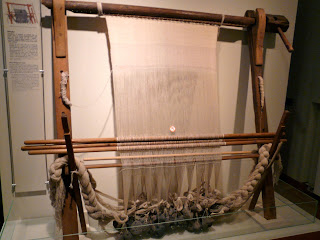
 Here are more grave goods (and house excavations) for women's work. The round stones are spindle whorls, the large ones are rocks for a warp weighted loom (pic below). The large piece is a whale bone beater for weaving, the small bones are sheep for winding thread to weave with. A very ornate iron needle case and whetstones (also from Norway due to geology) for sewing work.
 These are samples of the finely made homespun cloth, including some pattern work. The fabric does not usually survive well, this bits were protected by one of the large oval brooches against the ravages of time.


Notice the braid of yarn and the hanging rocks. This simple loom style was used in the far north of Europe thru the 19th century, it is easy to build and one can simply gather stones suitable for drilling to make the warp system. These are all volcanic rock, native Icelandic.

There's a lot more interesting fiber craft goodies, more to come in my next post!