Showing posts with label weaving. Show all posts

Tuesday, December 1, 2015

Anu's Farm

 (This is a continuation of a previous post, in which we visited a textile museum with the curator - Textile artist Anu Rand. Her artwork is a permanent gift from Estonia to the UN.)

Not only does Anu live in an idyllic little farm house, it's full of yarn! A traditional wood stove and classic textiles fill the farmhouse with a rustic feel.
And the weaving studio has baskets of yarn stacked in the corner. (I kept reminding Mr. Crafty that my yarn at least fits in a closet!) Anu showed off her looms and a finished piece, this one created during an artist residency in Finland.
Outside she has a herd of sheep. A wide variety of breeds and colors filled the field, munching away in the midsummer sun.
Anu has wool milled occasionally at a local place, but of course the sheep must be sheared no matter what! Fleeces were stored in this overhang of the barn, and we were invited to take home a handful. (I grabbed two!)

The garden was filled with all manner of veggie delights, and the usual greenhouse. Because of the short season and large temperature swings everyone seems to grow tomatoes and cucumbers in greenhouses. In the period after Soviet collapse (and at times during Soviet occupation), when food supply chains were not yet reestablished, many people subsisted almost entirely on tomatoes and cucumbers from their own gardens. We found that a plate of sliced fresh tomatoes and cukes were available at almost every meal, a staple garnish as it were.

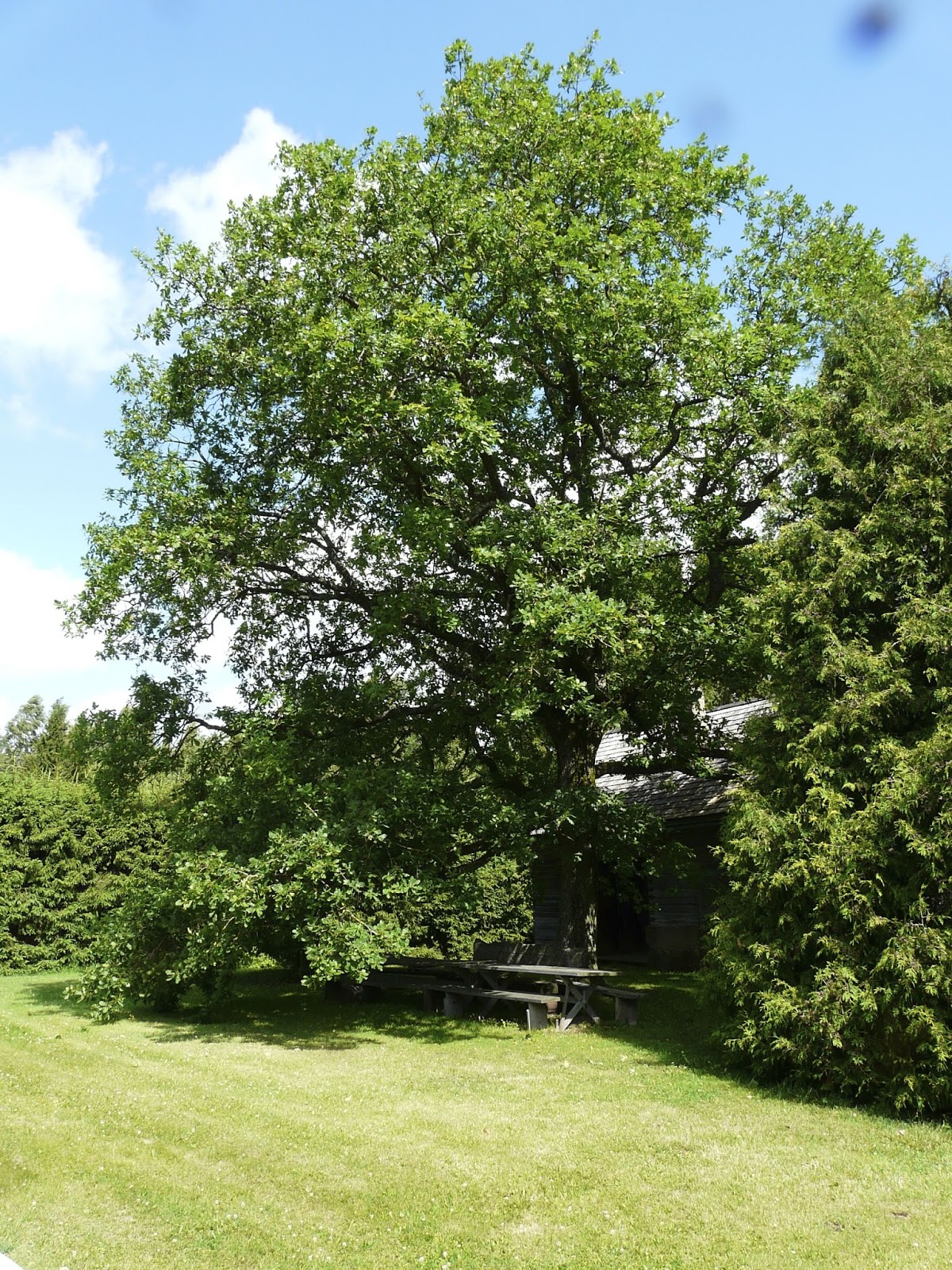
And this lovely oak! The farmstead has been in the family a few generations. This tree was planted by Anu's father, from an acorn gathered at his father's gravesite. A fantastic heirloom!
Scene's like this gave us a great temptation to more to Estonia and become farmers, but alas! My city loving ways are at odds with my farmhouse desires. It was wonderful to visit Anu's studio and hear her talk about her artistic process, her vision for Estonian handicraft, and the history of the area.

Monday, March 16, 2015

Looming Project

 At the start of the month I was invited to give a talk at Metro University for Women's History Month, and the theme this year is "Weaving our Stories." Naturally, I was there to speak on textiles, and on literal weaving. And so, I decided to make it interactive and give the attendees a chance to experience weaving.

I made a very simple frame loom, large enough for two people to stand side by side. This type of loom is commonly called a Tapestry Loom, and the warp will not show on the finished weaving.

I made marks every 10cm, then holding the two beams together I sawed a groove. I found that the only way to get good control was to draw the blade slowly towards me. I then screwed the top and bottom beam (with grooves) to the side beams, and used a piece of 2"x4" to make a base.
 I then warped the loom. Literally...

Usually one would turn around each groove and make a surface of warp threads on one face of the loom. I wanted the loom to be accessible from both sides to allow more people to work on it at once, so I wrapped the yarn all the way around the frame, making a continuous warp on both sides.

The pressure from all this tension, however, caused the loom to twist and warp slightly... oops?
I set up a selvedge to get the project going, and packed all my crummy yet brightly colored acrylic yarns into a bag. The loom will spend the month at the Gender Studies office, hopefully people will get a chance to weave on it, and at the end we'll have a crazy colorful woven fabric!

Tuesday, November 4, 2014

Schacht - Can You Dig It?

A few weeks back I took part in a marathon crafting extravaganza known as Spinzilla. We spun for seven days straight, and Team Fancy Tiger created a total of 171,492.6 yards of yarn, that's 97 miles in case you're wondering. That's the distance from Denver to Vail, New York City to Philadelphia, and (so my military historian partner tells me) the range of large artillery.

On the last day of the challenge Schacht, a local spinning and weaving equipment company, sponsored a spin-in and the Denver Art Museum. Between the camaraderie and the shit-talking we struck up conversation with some of the folks from the factory, and they invited us to come have a tour!
Dipping the wood pieces in an oil finish.


Racks of wheels ready to be assembled.

Does this count as a wheelwright? 


Machines neatly cut out flat pieces with very little waste. Some parts are cut from plywood, some from hard-wood planks.
Everything is very carefully sanded to make smooth tools.


The factory is always open for tours, just call ahead first! If you're a fiber artist, and you're in the Boulder CO area,  it's a fascinating experience. Even for the non-spinning-inclined the smell of sawdust and danish oil can't be beat. I personally love seeing how things are made, and many of these skilled workers are a joy to watch at work. Have any of you ever been to a factory?

Friday, August 24, 2012

Icelandic Fibercraft II

 More from the Icelandic National Museum.

This is a reconstruction of the types of homes used from the early modern period into the 20th century. The walls are lined with beds, and during cold days the whole family would sit inside. You can see there was spinning of course, but many other handicrafts were made. The bones and horns on the floor were likely used as toys, Icelandic children have a system of using different shaped bones to be different farm animals and buildings. (Yes, a little creepy. Yes, I will be giving my children a set of sheep bones for toys)
These elaborate ribbons are tablet weaving. After a very complex step of threading the cards one simply rotates the whole block of them, twining the threads and creating patterns. This is an art that makes me wonder - how did they come up with this?!
 Knitting was common of course, these are stocking forms used to create uniform sizes for export. On a small farm one would have to engage in a variety of industries, not only for subsistence but also for trade.
 This is bobbin lace. This set of tools belonged to a wealthier woman, likely in a city. Bobbin lace was very popular during the Edwardian and Victorian eras so it was likely made in smaller quantities by country folk as well.
 There were no artifacts related to embroidery, but we know that it must have been done, the "folk costume" has extensive embroidery. These colorful examples are all goldwork, and all made by the same women.

These styles of top is seen thruout Norse lands, with each region having distinctive motifs. All of the lovely clasp are silver wire work.
 Here's an older example with a cut lace apron on top. These are silk threads on wool.
 And here is some more modern examples of Icelandic "costume". An exhibit on local couture dating back to the twenties.

Wednesday, August 22, 2012

Icelandic Fibercrafts

Here's more artifacts for you fiber nerds...

A shoe made of woven cloth, a nallbinded (nallbound? nallbindinged?) mitten c. 11th century. Nallbinding is a technique that uses a darning needle and short pieces of yarn to make loops. The finished product resembles knitting, but is much sturdier as the loops will not unravel if one is broken. It predates knitting, and in fact knitting was not seen in Iceland at this time.
 Some appliqued embroidery work, many of the little bits are exotic velvets and silks. The rings are gilded leather set down with silver thread.
 Very detailed work with gold couching. Love it or hate it, religion causes people to make amazing things! These were vestments for priest made soon after the Christianization of the nation.
 Woven tapestries with religious and folk motifs. The nearest one is featured in a book I picked up which includes patterns, and I saw a simplified reproduction hanging in an embroidery shop.
 Knitting arrived on the island in the 16th century, and quickly became common. Warm goods made from woven fabrics are often clunky and stiff. These are sealskin shoes lined with a knit insole, a very cute one I might add!

Monday, August 20, 2012

Grave Goods and Goodies

We visited the National Museum in Reykjavik and spent some time exploring the collections. They are very proud of their settlement heritage and had wonderful displays.

These are all the Grave Goods of women, Vikings were generally buried with items they may need in the afterlife - from practical tools and clothing to horses and dogs. We can see how people lived by their graves, as it was expected that they would continue with the same activities in the underworld.
 These items are from a woman's grave in the 10th century. The large metal brooches held an apron across the front of her tunic and had a third piece strung between them. Jewelry is made of amber, rock crystal, and glass with metal. Combs are made of bone. There are scythes, scissors and a wool comb.
 These are brooches of metal and bone. The penannular rings are a Celtic design and probably traded. There were also buttons found at the sites, but they were used solely for decoration not for fastening.
 Here are grind stones for grains (barley is about the only grin that grows in Iceland's climes) and cooking pots. The iron pot is somewhat rare, most pots of that era are carved soapstone. Soapstone is not found in Iceland, so these were brought over from Norway - rich grave goods indeed!
 Here are more grave goods (and house excavations) for women's work. The round stones are spindle whorls, the large ones are rocks for a warp weighted loom (pic below). The large piece is a whale bone beater for weaving, the small bones are sheep for winding thread to weave with. A very ornate iron needle case and whetstones (also from Norway due to geology) for sewing work.
 These are samples of the finely made homespun cloth, including some pattern work. The fabric does not usually survive well, this bits were protected by one of the large oval brooches against the ravages of time.


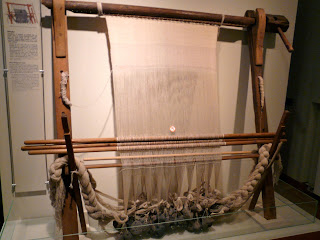
Notice the braid of yarn and the hanging rocks. This simple loom style was used in the far north of Europe thru the 19th century, it is easy to build and one can simply gather stones suitable for drilling to make the warp system. These are all volcanic rock, native Icelandic.

There's a lot more interesting fiber craft goodies, more to come in my next post!

Wednesday, December 29, 2010

Yarnia

No, that is not a picture of spaghetti night at my house, it is something far more yummy! Freshly spun yarn washed and soaking to be dyed. Yesterday was color day in my house, and the sweet smell of vinigar and wet wool heralds the coming of new yarns.

I did two simple colorways, the whole thing submerged in a light dyebath, and slowly pulled out as more color is added. Blues were the tone for the day since it's the color of winter, not that it's been very winter-y around here...


It was warm and sunny in fact, so I was able to hang the yarns outside to dry. The colors really pop in the sun! Wish my lawn was that green in the summer (>.<)


These two colorways, and some recently carded fiber blends will be popping up in my Etsy shop this week, for all your knitting pleasure. I hope many of you made a new year's resolution to be crafty!

Monday, August 16, 2010

More crafty tools, need more crafty time!


I pulled the loom out of my folk's garage and made space for it in my craft room. Now I have to get it working and start using it! It was actually rescued from a dumpster by my sister, and even folded it is tricky to put in the back of a station wagon so she drove it on top of the car to drop it off at my parent's. It's extremely old, and no info about the company is around the internet (that I can find anyway)
It's more of less complete, it's a four heddle loom with all the pieces there. Only one heddle currently hangs from the loom tho, and it is not hung properly. I am trying to figure out the system that was used to hang the pieces and connect them to the peddles, at that point I can warp it up and be ready to go! If anyone knows a loom expert please let me know...

Monday, June 15, 2009

Estes Park Wool Market

So I went up to the legendary Estes Wool Market this weekend for the first time. In fact it was the first time going to Estes in my life! (I know, born and raised in Colorado, but the 'rents don't care for crowds, so we stayed well off the beaten path.) Lot's of critters, lots of yarn, too much cute! Like the bunnies. Fluffy, fluffy, bunnies.

And the goats, like small ornery sheep they push around and butt their pens. Some as regal as this fellow, some recently sheared and scrawny looking....

Some desperately vieing for the days hay. All little guys, the tallest goat I saw was a Mama with bloated udder, just barely as big as an average sheep. But they seem about the same size around, just the legs are shorter. Much of the cuteness may be however, not in the diminutive size, but the lock of fuzz that obscures their eyes...daaaaaw!

Next I headed to the alpaca tent, in search of fluffy fleeces. This guy still has his fleece on, waiting to show before being sheared for the summer. He's a nice mottled color, and very proud. Not only did he get his own pen he wasn't nekked yet...

Of course that means he wasn't sporting a mowhawk either. That's right kids, if you let your family shave you for fiber they will leave you a little poof on top so you can hang with the cool kids. Alpacas of all colors hang together, no discrimination in the camilid world.

Next it was sheep time, curly haired teesdales...

And super shaggy I dunno what that is but it must be hot! The little ringlets hanging down are lovely, but it is summer here.
Most of the sheep were more ordinary types, just fluffy white things! (ok, not really white, they do get a little dirty after all...) Many sheep were in all kinds of high tech form fitting blankets to keep the fleece clean, I kinda like a little bit of "barnyard matter" to remind me were the yarn comes from, maybe just me.

Then there was a tent marked "Paco-vicuñas". They are a cross-breed, mixed with their wild ancestors. They have a fleece with very fine fibers (20 micron or so...) This guy is desperately trying to explain why the fiber is $25 bucks an ounce...

Then there is the seep to shawl team. Seems only one team showed up this year, too bad (any one wanna do it next year? I got a loom..) but these ladies did it anyway! Each day of the fair these ladies had been starting at 8:30, carding and spinning off a washed fleece to supply yarn for the weaver...

The weaver starts her day with a warped loom, and waits impaitently for the bobbins to be filled. She was nearing the end of her warp by 2 PM and preparing to take her product to the judging tent (gee, I wonder what place they'll get, I hop the judge gives them good feedback!), A lovely white shawl in a subtle weave pattern.

All in all a good way to spend a Marvelous Sunday afternoon in the Mountains of Colorado!