Showing posts with label plants. Show all posts

Friday, March 11, 2016

Spring Soup - Herbal Cold Remedy

It's spring time in the Rockies, which means 70 degrees in the city, raging blizzards in the mountains, and wind every afternoon. It also means it's the last round of illnesses floating around to catch the ill prepared victim... (This week it's Me and Mr. Crafty.)

So, I did what any good hedgewitch would - I went to the garden! Firstly, because it needs doing. It's tradition in our family to plant peas and radishes on St. Paddy's Day, but with the climate shifting I'm trying a week early this year. Thus, the beds must be turned! 

Secondly, to get some dandelions for eating. Gardener's reward.
 However, in my digging I discovered that I had missed a few carrots in the final harvest (Including that white one! It might be the biggest I've ever grown!? How?!) Which means that I can create the perfect remedy - soup. There's a reason that folk medicine around the world doses soups out for the common cold, hydration, warmth, salt, and herby goodness. Not to mention that it's tasty.

And so, my March harvest for soup included Dandelion greens and root, carrots (even a little sprig of greens!), leek, chives, and sage. Not pictured are the two non-homegrown ingredients - chicken and ginger root. A nice balance of nutrition, fuel for the body, and herbs to stimulate the immune system. Other good herbs that might be overwintering nicely include thyme, garlic, hyssop, oregano, yarrow, and lemon balm.

Why no noodles? Not needed, for me at least. I do recommend noodles over most other starches, however. Simple starches like potatoes and rice will spike the blood sugar which does not encourage good immune function. On that note, Orange juice is great for staving off sicknesses, but once you're sick try an herbal source of the C, like rosehips or nettles, to avoid the high sugar content of juice.

There you go, fresh foods for natural healing! It should be pointed out that our ancestors did not, as one might expect, struggle for food the most during the cold of winter. It would be the early spring that was toughest, when the stores were depleted but most crops were not yet thriving. Thus, very early wild foods like Dandelion, Arugula, Asparagus, and the like would be important forage in the spring!

It may be no instant cure, but I certainly feel better after a day in the sunshine and a nice bowl of hot soup! What's your favorite spring food?


Tuesday, June 16, 2015

Wormwood - Poison, or Healing Herb?

The Green Fairy 
The absinthe craze of the previous centuries has given Wormwood a rather large, and fearsome, reputation. Poets would claim it gave them visions, authorities would claim it poisoned drinkers. Some folks still claim it has properties, both magical and psychoactive. But this silvery leaf, "bitterest of herbs" is more mundane than we realize (I do not mean that as an insult!)

I discovered, some time ago, that the fragrant, soft-leaved plant growing next to my shrine is a member of the Artemisia family, most likely A. absinthium - wormwood. It makes a robust tea that causes the lips to tingle. But, isn't it dangerous? In the 19th c. there was great concern about the dangerous wormwood, supposedly laced with toxic wormwood in great quantities and causing madness in those who consumed it. 

However, it is far more likely that unscrupulous makers were attempting to get that prized "fairy green" color, and using toxic additives for color, including mercury compounds. And of course, Absinthe is a strong drink, perhaps in attempting to obtain an exciting high from the Thujone, people were simply becoming drunk!
A "dangerous" plant, looking rather innocent.
Modern testing to determine the usefulness of wormwood as a drug have shown that the Thujone content can vary wildly, growing conditions and strains can impact the concentrations in a variety of ways. But even the strongest plants had very small amounts, hardly enough to "get high". Similarly, the alcohols made from Wormwood (Which include Pernod, vermouth, and chartreuse) very in thujone concentrations, but are never very strong. (Let's be clear, they are strong in booz-ocity!)

But, as an herb it has many uses besides summoning hallucinations! It's soothing on the stomach, improves circulation, brings on the menses, and as the name suggest, it helps to expel parasites.  In fact, some people suggest its use around the house to repel insects! It can, however, if taken in vast quantities damage the kidneys. Then again, so can black tea.

Dried bundles for smudging.
Magically, it is connected with the graveyard. It is often used around Samhain for rites and cleansing, and to summon the spirits of the dead. I suppose that's a bit like having visions, but not quite how the romantic poets described it...

Wednesday, March 18, 2015

Greenin' Time

It's that time of year again - garden fever is gripping me and seeds are being sown. I started tomatoes, peppers, and eggplants in greenhouse boxes (upcycled lettuce bins) back in February. Yeah, when it's cold and snowy I plant seeds, totally makes sense. I'm preparing to transplant into little paper pots (see my how-to about it here), and very soon they will be clamoring to go out into the ground!

 Of course, as family tradition dictates, the peas were planted on St. Patty's. As were radishes and carrots. All plants that can stand a snowfall or two, which we will certainly have before summer is fully here.
And in the herb beds, new leaves are appearing. Last winter it never became harsh enough to force many of my perennials into dormancy. This year most of them lost all leaves, had stems broken off, and generally disappeared into the ground. I'm waiting anxiously to see if they all return!

It's the season for preparation, what are you doing in your garden?

Sunday, November 9, 2014

Plant Dyes - Bindweed

Another round of plant dying experiments. This time I'm targeting perhaps the most plentiful plant material on our property - Bindweed. That's right, I wasn't neglecting my weeding, I was collecting important dyestuffs! 

In to a pot it went, covered with water and boiled for several hours, then left overnight.
My resource is an old book,  perfect for my project! Rocky Mountain Dye Plants by Anne Bliss (What a great name!) It has a broad swath of plants, identification information, and descriptions of the colors achieved with different mordents.


The fibers are Lincoln roving, Norwegian top spun chunky, and 2-ply Irish wool, plus some crewel wool.

First, the wool must be soaked, then simmered in alum as a mordent. While that was happening I removed the plant material from the dye pot, as bindweed is a tangly mess it was pretty easy! As always, a few leafy bits remained.

I simmered the wool on low for several hours, then left it overnight again to cool. The color hadn't deepened much since the day before.
It took several rinses to remove the excess dye, but the color didn't fade in the least!


After drying in the sun it was looking a pleasant creamy gold. The color is a bit light for me, in the future I'll need to pack in some more bindweed! Or, it may be because the plants were gathered at the end of the season, a comparative dye might need to happen next spring. I can bet that there will be lots of bindweed again...


Monday, October 20, 2014

Plant Dyes - Elderberry


I dedicated myself in the summer to building my repertoire  of plant dyes in the next year. Since one must gather as the year turns, it was time for Elderberries. It's the last of the season for berries, most had begun to wither and dry on the trees. Since I did some very large batches of syrup earlier in the year all the berries I gathered wen into the dye pot.

For the dye materials, I got into my Spinzilla stash. Irish wool, sock-weight Lincoln, and a loop of Lincoln roving. It was all pre-mordanted by soaking in alum and hot water for several hours while the dye bath simmered. Mordanting outside of the dye bath works better, as the mordant can bind up dye particles thus making them unavailable for binding to the fiber.
I left the fiber to soak in the residual heat from the simmering overnight. Plant dyes seem to need loooong soaking! Elderberry is usual considered a fugitive dye, that means that it is not terribly colorfast. (Despite how one's kitchen looks after cooking with it!) I have read some research which suggest that one can add vinegar to create a very acid bath and make a better, more long-lasting color. I thought that after one night the color was a little pale, so I placed it over low heat for another day, and let it set overnight.  I also added more white vinegar.
 The next morning the color was more purple, and had set in a little bit more. It still had a few elderberries floating around and adding in color!
 I washed the fiber, and it became disappointingly pale pink, not a bad color really, just a bit less intense than the dye water made it seem! After hanging outside to dry the color had matured to a more gray-purple. Nice and heathered. I'm planning to let the fiber sit for a while in a light room before knitting in case it fades completely!
For a first shot at this color it's not bad. Next up I'll be moving away from the food-based dyes (Which tend to be less colorfast) and into wild plants and trees. Bindweed seems like a perfect choice as there is no lack of it right outside my back door! How do you push your craft skills?

Thursday, March 6, 2014

Plant Dying in the Kitchen


In preparation for Eoster my Grove will be dying and decorating eggs, and I decided it was time to experiment with some plant dyes. Our ancestors, of course, were able to coax a rainbow of rich and lasting colors from plants and minerals. My past attempts however, have yielded blah brown, slightly greener blah brown, and dark blah brown.

 I decided to start therefore with some of the more tried and true vegetable based colors. Onion skins (yellow and purple), red cabbage, red beets, and fennel. For the beet dye I used the stems and skins of the beets, steamed the root over the mix, and have been eating the beets while stirring the dye stuff. For the Onion skins I saved up a few months worth (we eat a LOT of onions, so that was a large quantity.) It was suggested that one use only the top of the fennel to get a nice yellow, I got nothing from it. Upon further research, the fennel bulbs one gets at the grocery store are NOT the right variety to make dye. Oh well, at least I get to eat it!

This project took over the entire kitchen for the day, I simmered the plant stuffs in water with salt and vinegar. then strained them and poured off half into jars to keep for egg dying day. I added pre-washed wool roving and left them to simmer for several hours.
When I was adding the wool I also put Alum as a mordent. Alum is usually considered to be a relatively "neutral" mordent that doesn't change the colors as extremely as other harsher chemicals. However, when added to the red onion skins, black magic happened! I kept reading that red onions made a "jade green", and I kept thinking that people are freakin' crazy. I've dyed cotton with red onions before and never gotten anything but a light pink! Buuuuuut, then I added alum and shit got cray - instant change to deep green. Science... or something?


After simmering for a while, and sitting to cool for several more hours, the wool was rinsed out and hung to dry. The colors seemed to lighten up a good bit in the drying process, but the colors are still fairly vibrant. It's true the old observation, that plant dyes have more depth. After spinning the wool has a nice luster, with almost shimmering layers of subtle color!

This summer I plan to gather more wild plants for dying, and keep experimenting with different species and mordents. Have you ever tried plant dying? What is your favorite kitchen color?

Saturday, December 21, 2013

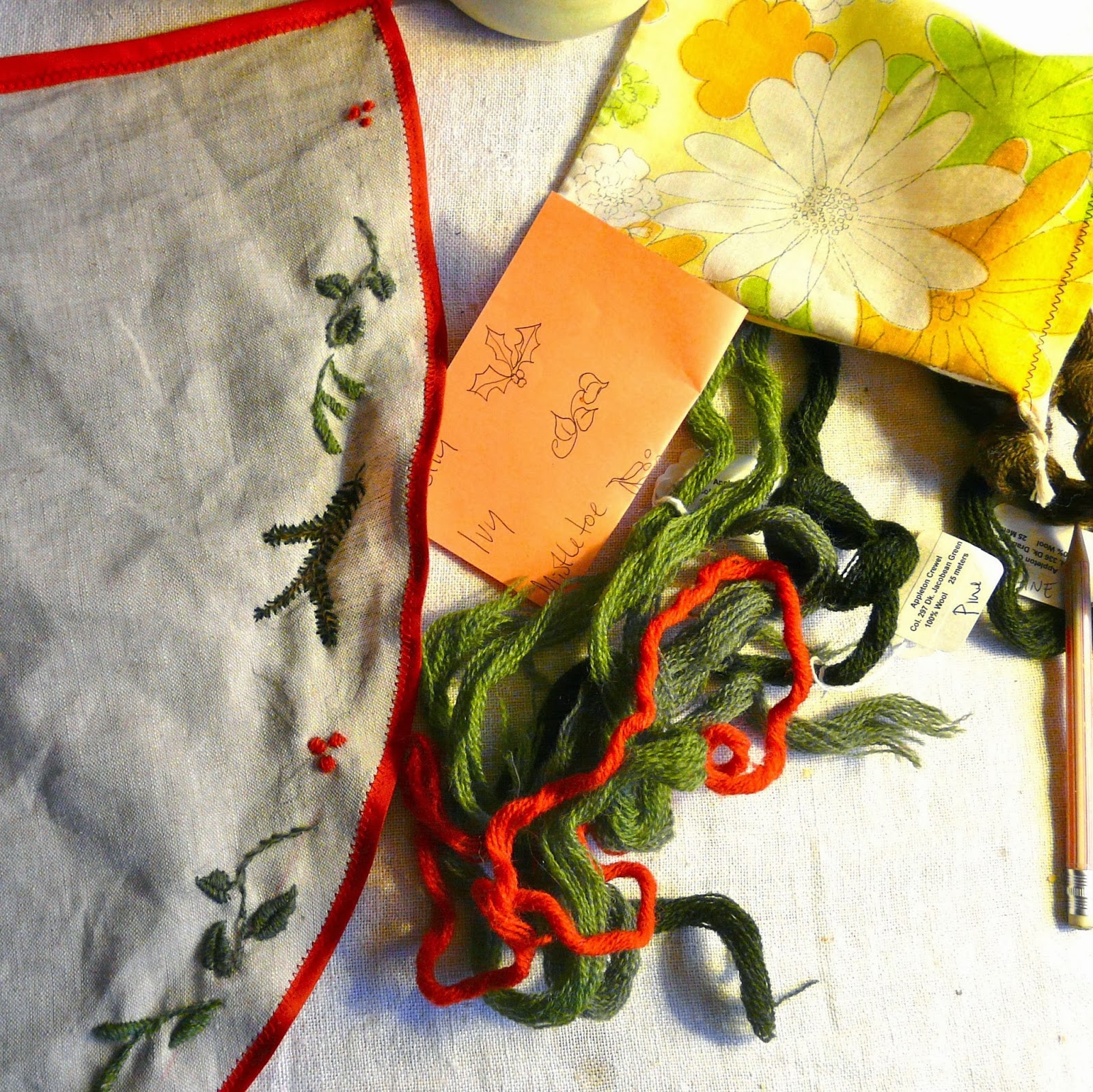
Embroidered Tree Skirt

Last year I was inspired to create an heirloom piece for our Yule tree. This is, in fact, a big step for me. I have long despised the holiday season, mostly because it starts in September. I am the 'bah humbug' shouting obscenities at holiday decorations that go up before Thanksgiving, and shoving headphones in my ears as soon as the bad Christmas music is heard in stores.
But, like the grinch, I am softening back to the season. I have always loved snow. I have always loved fire. Now that Yuletide means a gathering of friends with good food around a fire on a long cold night... it's not so bad. So, for the first time, we cut a real tree in the mountains and decorated it with my odd collection of ornaments. Such a tree is worthy of a good skirt!


I decided on several traditional winter symbols - Holly, Ivy, Pine, and Mistletoe. All are noted for staying green through the winter, and thus are considered signs of rebirth, fertility, and heralds of spring.


I chose a different color for each plant, and a simple arrangement of three leaves for each. the backdrop is a linen blend trimmed in red bias tape. I had a heck of a time getting it round!
The happy kidney bean likes it!

Wednesday, January 16, 2013

Tea Time

Every morning my "Mr Coffee" bubbles and steams, but it doesn't have roast beans inside. Personally I've never like coffee, and the caffeine doesn't seem to make me more productive.

I prefer to fill my carafe with herbs and spices, and let the infusion wake me up by scalding my tongue. (Pro-tip, not actually a good way to wake up.) Officially any soaked herb water other than Camellia sinensis is called a tisane, and I prefer the herbal stuff. It may seem rather daunting and complex to find good, inexpensive, delicious herbal concoctions, but you may be able to start in your kitchen and backyard.

Photo - http://www.thehomeherbalist.com/roman-chamomile-essential-oil/

Chamomile is a common tea, but it need not be relegated to bedtime! Besides calming, it helps fever, upset stomach, and menstrual cramps. It is antiseptic and makes a great external wash for wounds, bug bites and rashes. I find it likes to mix with many different flavors, thyme, berries, lemon balm, and rose all mix nicely with chamomile.

Photo - http://semiswede.com/2011/06/09/elderflower-liqueur/
Elderflowers are delicate enchanting blooms with a heady scent and light flavor. Many a fine liquor and jam is flavored with elderflower. Elderflower bushes are said to host fairies, and you should always ask the Elder plant's permission to pick anything from it. The flowers help with fevers and lung problems, and sore throats. I like Elderflower by itself for the delicate taste.
Photo- http://theherbgardener.blogspot.com/2007/11/sage-is-good-for-more-than-stuffing.html

Sage is truly an unappreciated herb, it belongs in more than sausages and stuffing! It is antiseptic and drying, so it can be used to calm sweating and mucous. It's a wonderful gargle for sore throats. It helps slow diarrhea. I like it best with elderberry or rosehips to give it a fruity edge.
Photo - http://juniperdesert.com/beauty/lavenderforburns

Lavender is a classic culinary and medicinal herb. It's calming and soothing effects pair nicely with it's musty heady smell. The oil is slightly antiseptic and soothes cuts and burns. As a tea it calms and relaxes, allays headaches and nausea. I like it best with other flowers, like chamomile and rose, but lavender shines quite well on it's own!

The best herb teas are made with water just under boiling, and left to infuse for quite a while. Use a little local honey if you like it sweet, the medicinal effects of honey will enhance the medicinal effects of most herbs. More importantly it's tasty! What is your drink of choice in the morning?

Wednesday, May 9, 2012

Rose Harvest

 I am lucky enough to have two sprawling summer roses on my property, one yellow and one red. Each one explodes in a shower of blooms this time of year and gives off a heavenly scent into the yard. While a lovely flower, one cannot overlook the practical uses of roses as well.
In order to get the best harvest, I pick the petals carefully. You see, the fruit of the plants - a rose hip - is every bit as desirable as the flowers, and I want to have my cake and eat it too. I wait until the petals of the flower are starting to wilt and fall off a bit themselves, then I carefully pull them off, leaving behind the stamen and pistil to allow for the fruit to mature. This careful act also lets you shake out any insects that may be hiding in the flowers.
Now the petals have a slight astringency to them and are recommended for stomach ills and ulcers. They are also delicious! I like to throw some into iced teas and herbal concoctions for the yum factor. Since they are so light one can easily dry them in the bowl you used for gathering, simply turn and fluff them a few times a day as they sit in a cool dry place. Be sure to stick your nose in the bowl every time you check them, just because you can.
 While these yellow ones are destined for teas and tinctures, the bright pink bush is being collected for a special project. I just decanted my first two batches of mead into bottles, and I'm starting a batch that will become a rhydomel, Greek style rose mead. After the initial fast ferment I will add as many cups of rose petals as I can muster to (hopefully) make a nice pink boozy sparkling beverage.
That's not all! I also like to use pink ones to make a rose syrup, perfect for cocktails and teas, perhaps even lemonade? The hips are a great source of vitamin C and make a perfect addition to immune boosting teas in the fall and winter. Many people even make jams, but I'm not sure my bushes are big enough for that kind of shenanigans. Have you checked your yard for flowers that are edible or medicinal? You may be surprised at what you find!